































Pneumatics|Automation|Published Oct 22, 2026|13 MIN READ
Need More Lifting Force from a Compact Cylinder? How to Evaluate SMC CQE vs. CQ2/CDQ2
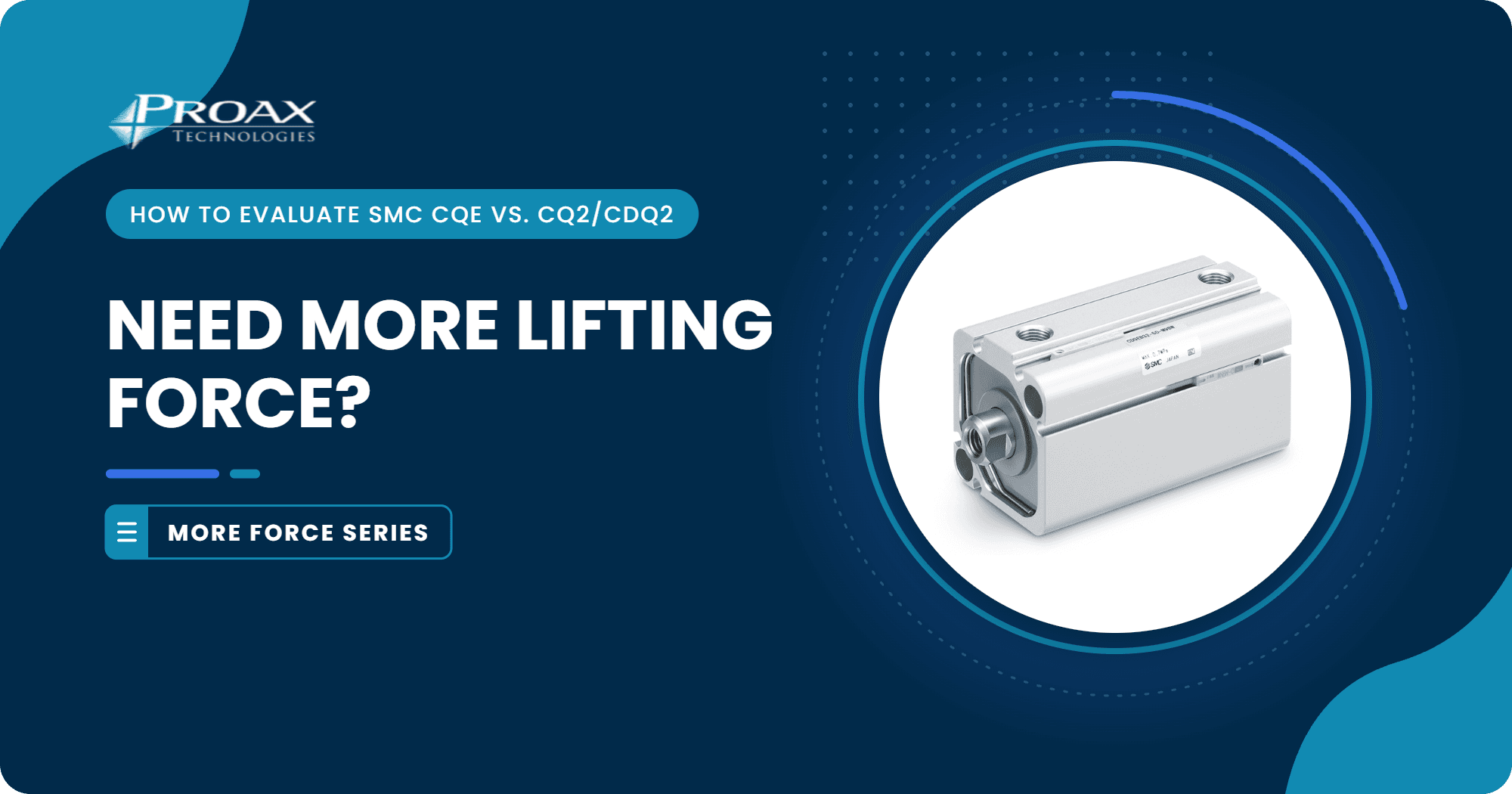
To get more lifting force from a compact cylinder, calculate the force at your actual operating pressure, in the direction that does the lifting, then choose a route: a high-power SMC CQE in the same body size, the next bore up in the standard CQ2 line, or more pressure on the existing cylinder. None of these is automatically a drop-in replacement, so confirm bore, stroke, mounting, rod end, ports and sensors, then check current availability with Proax.
A familiar request: a 32 mm compact cylinder on a lift or press station does its job, but the process now needs roughly 25 to 30% more force, and the high-power replacement is made to order. The steps below show how to compare an SMC CQE high-power compact cylinder with a CQ2/CDQ2, and when a different route is the better answer.
Is There a Faster-Available Option With 25 to 30% More Lifting Force?
What Is the Current Lead Time on a Standard Compact Cylinder?
Which Cylinder Has This Bore and Stroke?
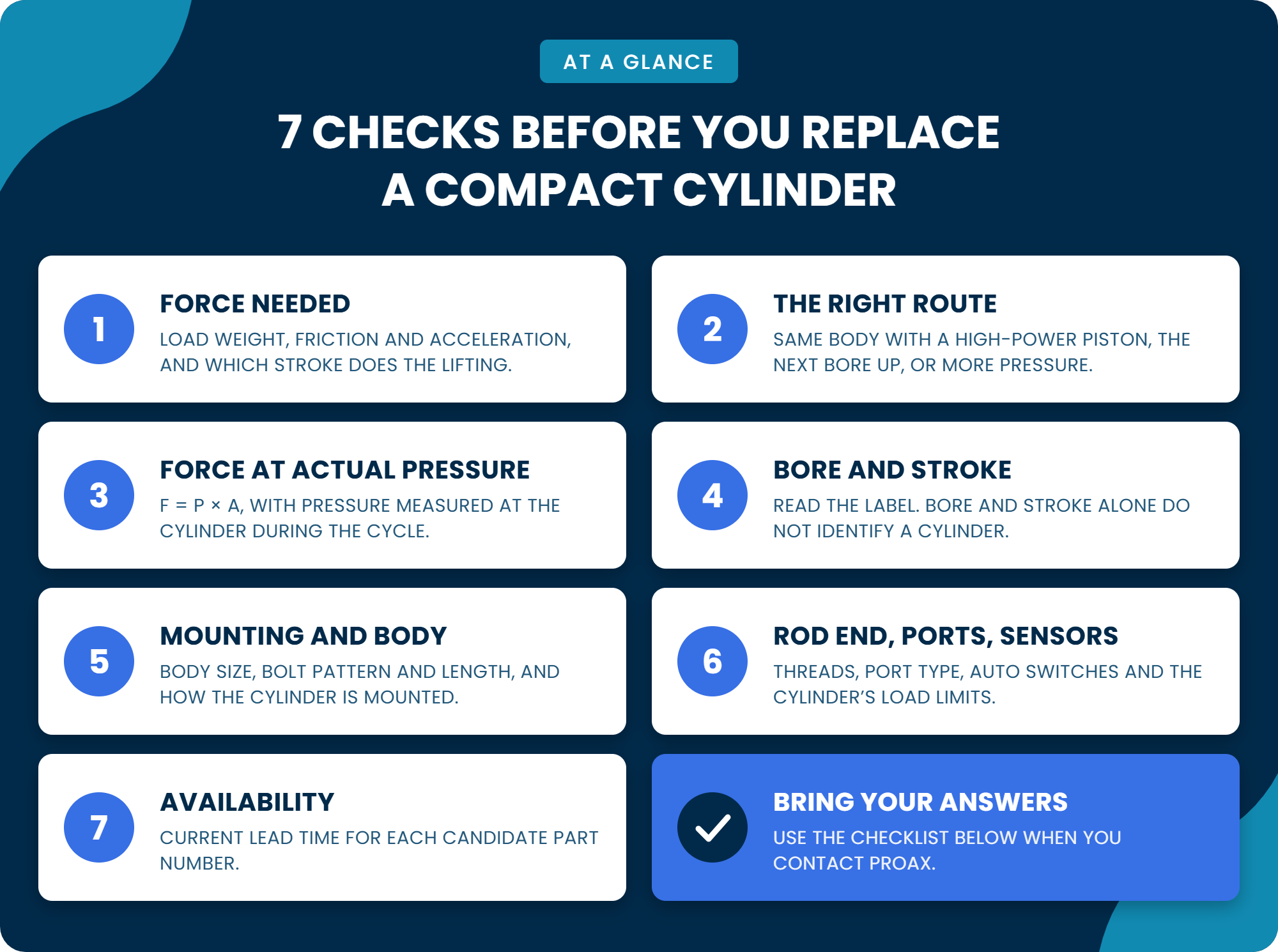
1. How Much Force Does the Lift Really Need?
Start with the load, not the cylinder. Then compare that need with what the current cylinder delivers. "25 to 30% more" only becomes useful once it is a number of newtons at a known pressure.
Pushing up from below lifts on extension. Pulling up from above lifts on retraction, which has less piston area because of the rod.
Rule of Thumb
Theoretical output is not usable force. Many designers keep a moving load to about half of theoretical output to leave margin for friction, acceleration and pressure drop.
2. Which Route Gets You There?
There are three common ways to get more force from a compact cylinder application. All three can reach a 25 to 30% target; the right one depends on the space around the cylinder, the mounting, the pressure available and the lead time on each part.
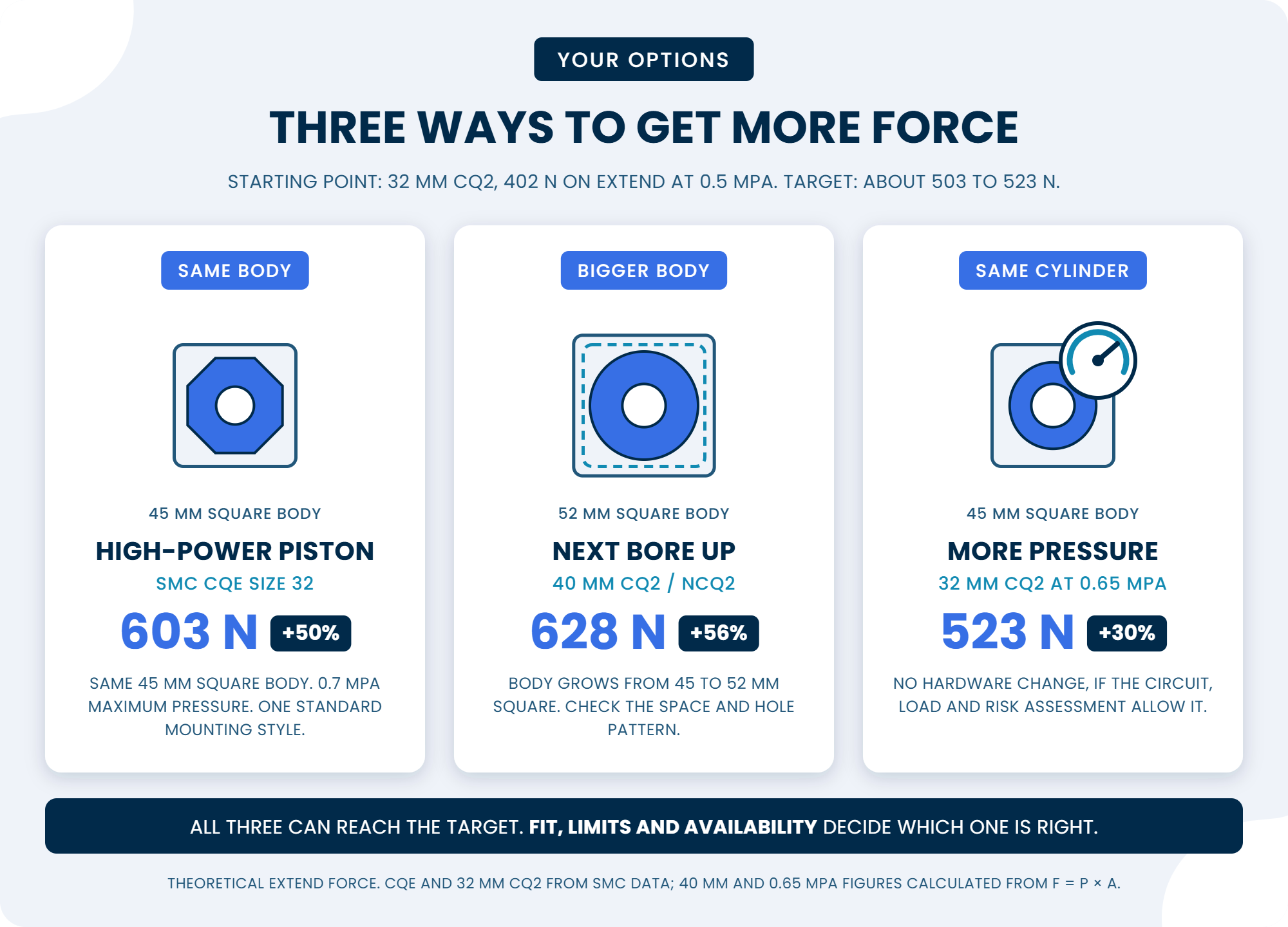
High-Power Piston
- Same 45 mm Square Body
- 0.7 MPa Maximum Pressure
- One Standard Mounting Style
- Check the Made-to-Order Lead Time
Next Bore Up
- Body Grows From 45 to 52 mm Square
- Mounting Holes Move
- Needs More Space Around the Cylinder
- Standard Line, Often Easier to Source
More Pressure
- No Hardware Change
- CQ2 Rated to 1.0 MPa
- Check the Valve, Fittings and Load
- Confirm With Your Risk Assessment
3. What Force Does Each Option Give at Your Actual Pressure?
Theoretical force is pressure times piston area: F = P × A. For a round piston, A = π × D² ÷ 4 on extension, minus the rod area on retraction. The CQE’s polygonal piston gives a size 32 body about the piston area of a 40 mm bore, so use SMC’s output table for the CQE instead of the round-bore formula.
| Option | Body | 0.4 MPa (58 psi) | 0.5 MPa (73 psi) | 0.6 MPa (87 psi) |
|---|---|---|---|---|
| 32 mm CQ2 Starting Point | 45 mm | 322 N | 402 N | 483 N |
| SMC CQE Size 32 High-Power Piston | 45 mm | 482 N | 603 N | 724 N |
| 40 mm CQ2 Next Bore Up | 52 mm | 503 N | 628 N | 754 N |
Measure at the Cylinder
Measure pressure at the cylinder while the machine cycles, not at the compressor. Long lines, small valves and shared headers can leave the cylinder well below the regulator setting.
Worked Example
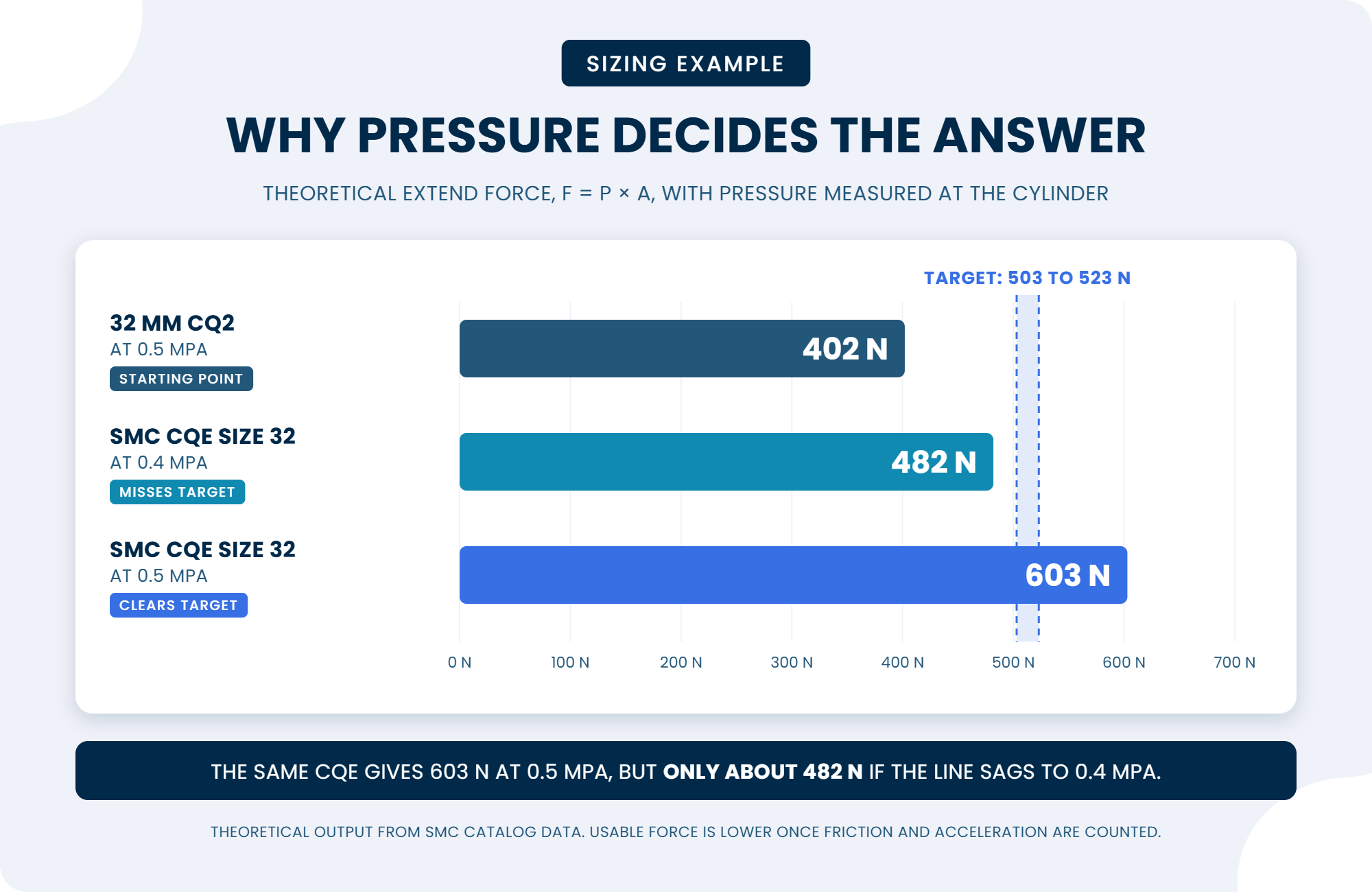
At 0.5 MPa, a 32 mm CQ2 extends with 402 N, so a 25 to 30% increase means about 503 to 523 N. A CQE size 32 gives 603 N at the same pressure, about 50% more. If the line at the cylinder sags to 0.4 MPa, the CQE gives about 482 N and misses the target.
CQ2 Maximum Pressure
Raising a 32 mm CQ2 to about 0.65 MPa gives roughly 523 N on extension, if the circuit allows it.
CQE Maximum Pressure
The CQE gets its extra force from piston area, not pressure. Do not plan above 0.7 MPa.
4. Do the Bore and Stroke Match?
Bore and Stroke Alone Don’t Identify a Cylinder
A request for about 32 mm bore and 90 to 100 mm stroke can turn out to be a round-body cylinder rather than a compact one. Read the full part number from the label, or send photos of the label, body, mounting, rod end and ports.
If you are moving to a CQE, check that its size and stroke range cover what you need:
Intermediate strokes come in 1 mm steps, either as a spacer in a longer body or as an exclusive body, and the two have different overall lengths.
5. Will the Mounting and Body Fit?
In a part number such as NCDQ2A32-25DZ, the A means both ends tapped. Compare the drawing with the installed part either way, and check body length at the chosen stroke, bolt pattern and bolt length.
Several Mounting Styles
- Both Ends Tapped (A)
- Through-Hole
- Foot, Flange and Clevis Options
- 45 mm Square Body on the 32 mm Bore
One Standard Body
- Through-Hole and Both Ends Tapped
- Same External Dimensions as the CQ2
- Mounting Bolts Ordered Separately
- Foot, Flange or Clevis Setups Need a Closer Look
6. Do the Rod End, Ports, Sensors and Load Limits Work?
Rod End
Female thread is standard, with a male-thread option and made-to-order rod end shapes. Match the existing floating joint or tooling.
Rod Rotation
The polygonal piston keeps the rod from turning in normal operation, but it is not a guide for side loads.
Ports
The CQE catalog lists Rc1/8 ports on sizes 32 and 40. Confirm the thread on the existing fittings.
Auto Switches
With the built-in magnet, the CQE takes SMC’s compact D-M9 solid-state switches. Check the model and wiring.
Load Limits
Check piston speed, allowable kinetic energy and lateral load at the rod end. More force does not raise these limits.
Lead Time
Made-to-order and standard parts can have very different delivery times. Check each candidate.
7. Is the Part Available When You Need It?
Lead time can decide between technically sound options. A made-to-order CQE and a standard CQ2 or NCQ2 configuration can have very different delivery times, and both change. Send Proax the exact candidate part numbers so we can check current availability and lead time for each before you commit.
Where the SMC CQE Fits
The SMC CQE may suit lifts, clamps and press-fits that need more force in the same space, or the same force at a lower pressure. Explore SMC at Proax for configuration and quotes.
More Force
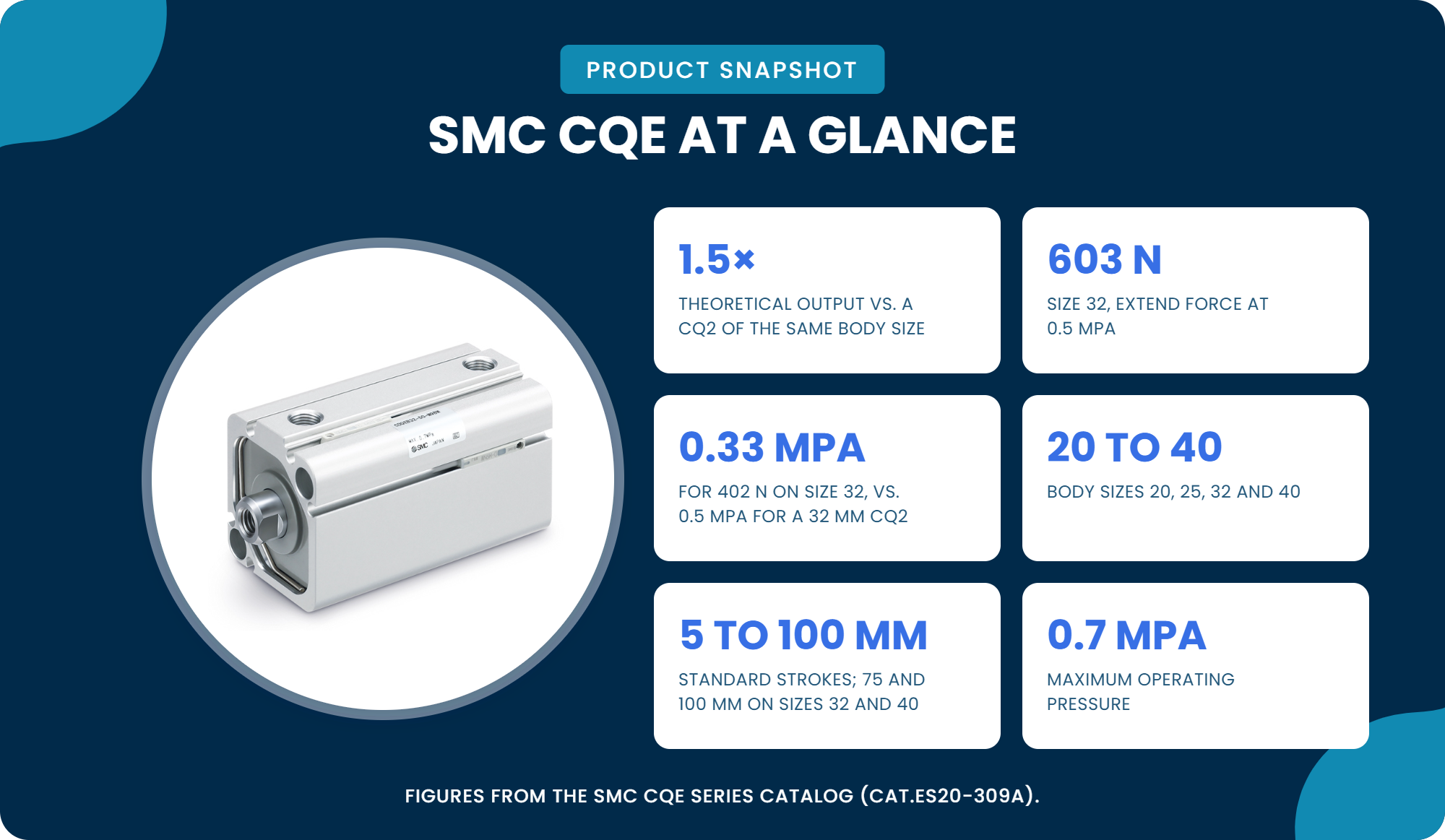
Size 32: 603 N on extension at 0.5 MPa, compared with 402 N for a 32 mm CQ2.
Lower Pressure
Size 32 reaches about 402 N at 0.33 MPa, where a 32 mm CQ2 needs 0.5 MPa.
Sizes and Strokes
Sizes 20, 25, 32 and 40. Strokes 5 to 50 mm, plus 75 and 100 mm on sizes 32 and 40.
Mounting
One standard body: through-hole and both ends tapped.
Rod
Non-rotating in normal operation thanks to the polygonal piston. Female or male rod end.
Sensing
Built-in magnet option with compact D-M9 solid-state auto switches.
Sources: SMC CQE series product information and SMC CQE series catalog.
When a CQ2 or CDQ2 May Still Be the Better Choice
- The Circuit Runs Above 0.7 MPa
- The Machine Uses a Foot, Flange or Clevis Mount
- The Stroke Is Longer Than 100 mm
- There Is Room for a 52 mm Body and a 40 mm Cylinder Meets the Target
- A Modest Pressure Increase on the Existing CQ2 Covers the Target
Checklist: What to Gather Before You Contact Proax
A Compact Cylinder Replacement Review Goes Faster With This Information:
Need More Force From the Same Space?
Send your current part number, operating pressure and load, and our in-house team will help you compare options and check lead times.