































Pneumatics|Automation|Published Oct 29, 2026|13 MIN READ
Need More Pressure at One Machine? How to Size an SMC VBA Booster Regulator
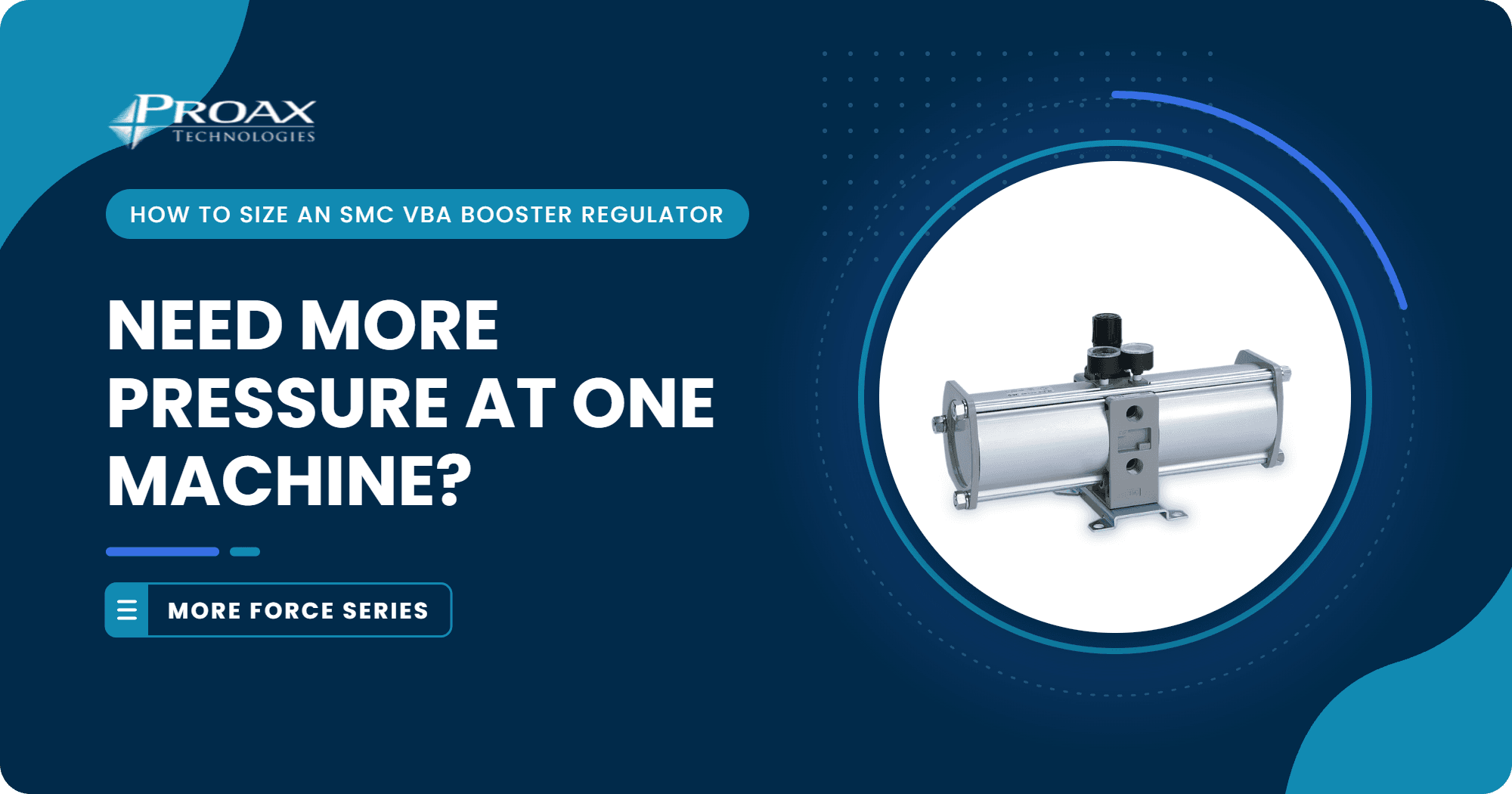
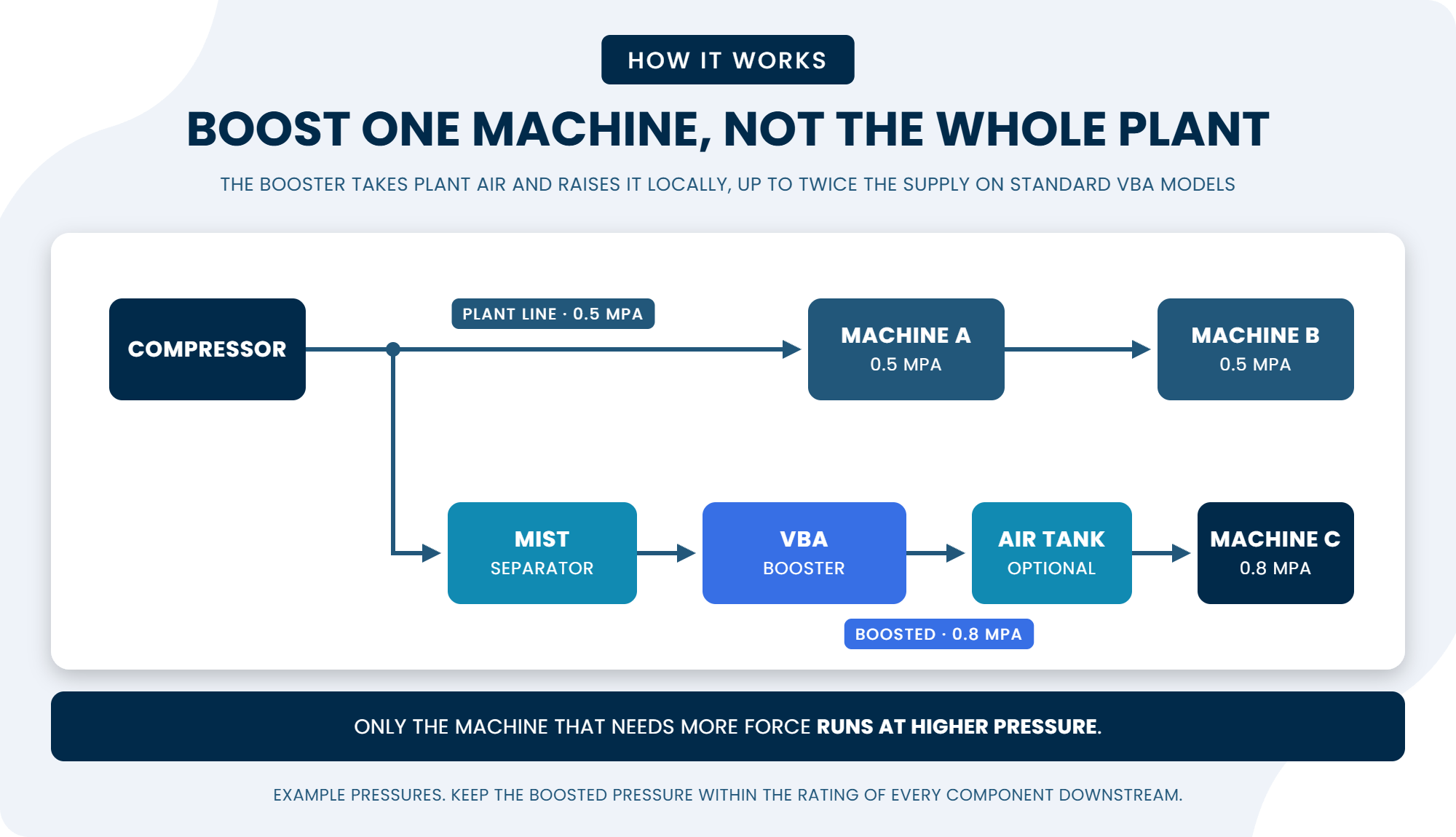
A booster regulator such as the SMC VBA raises air pressure locally, up to twice the supply pressure on standard models, so one machine can get more force without raising pressure across the whole plant. Before choosing one, work out the pressure you need at the actuator, check the flow and whether demand is continuous or intermittent, and confirm that everything downstream is rated for the boosted pressure. Then pick the model, decide on an air tank and plan the installation.
This post follows on from our guide to the SMC CQE high-power compact cylinder, which covered three ways to get more force from a compact cylinder: more piston area, a bigger bore or more pressure. Here we look at the pressure route in more detail, using an SMC VBA booster regulator to raise pressure at a single machine.
The Plant Line Sags Below What One Station Needs
A Single Press or Clamp Needs More Force Than the Rest
There Is No Room for a Bigger Cylinder
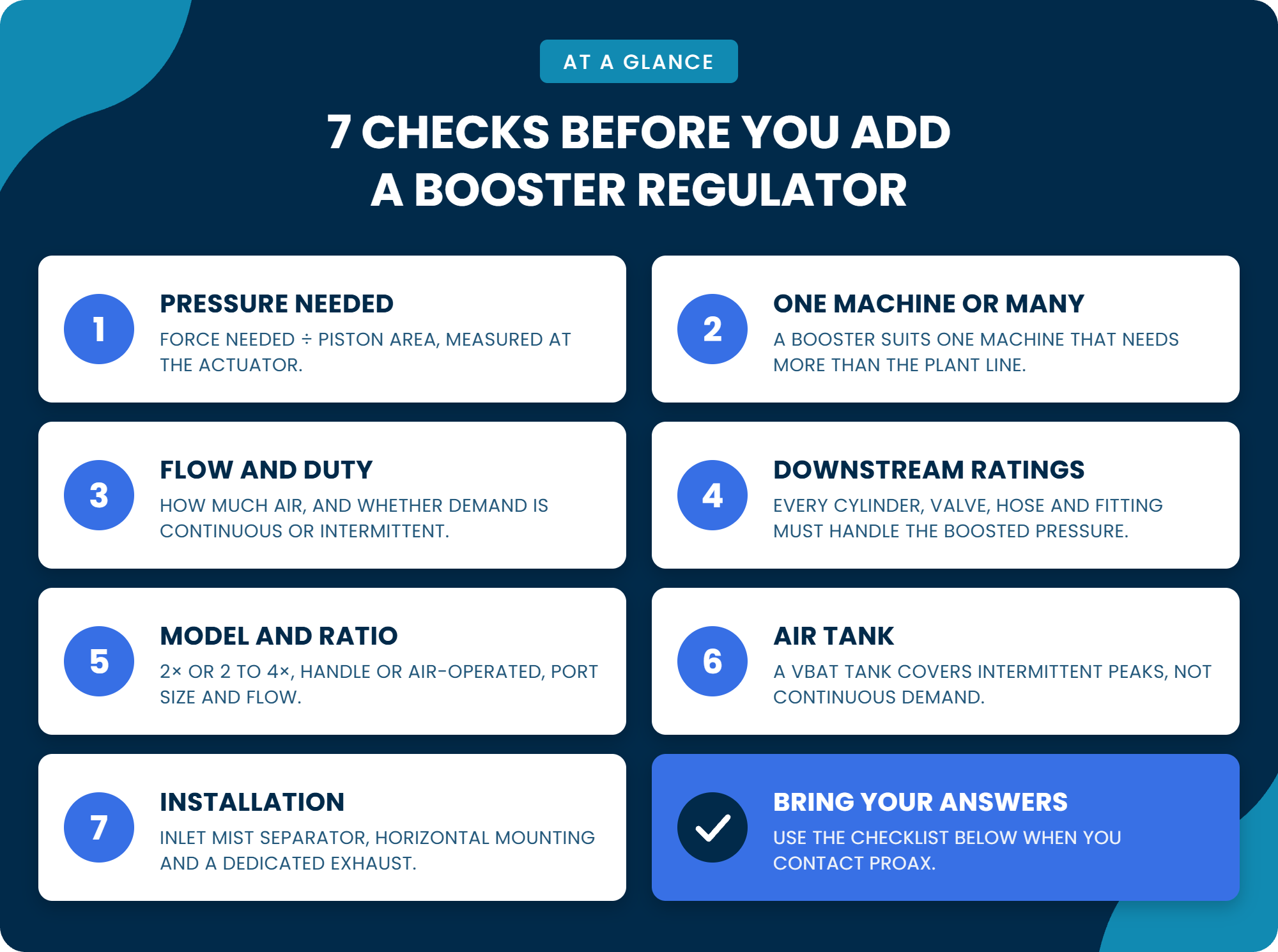
1. How Much Pressure Do You Need at the Actuator?
Start with force, then work back to pressure. Divide the force you need by the piston area on the side that does the work. On retraction, the rod takes up part of that area, so the same pressure gives less force.
For a 32 mm bore, the piston area on extension is about 804 mm², so every 0.1 MPa adds roughly 80 N of theoretical force.
| Bore | 0.4 MPa (58 psi) | 0.5 MPa (73 psi) | 0.65 MPa (94 psi) | 0.8 MPa (116 psi) |
|---|---|---|---|---|
| 32 mm Extension | 322 N | 402 N | 523 N | 643 N |
| 40 mm Extension | 503 N | 628 N | 817 N | 1005 N |
Measure at the Machine
Check the pressure at the actuator while the machine cycles. If it only sags during peak demand, fixing the supply line or adding a tank may solve it without a booster.
2. Is a Booster the Right Route?
A booster makes the most sense when one machine needs more pressure than the rest of the plant. Raising the compressor setting pushes every line higher, while a booster keeps the main line where it is and raises pressure only where it is needed.
Add a Booster
- Raises Pressure at One Machine
- Main Line Stays Where It Is
- Needs Space, Piping and an Exhaust
- Uses Part of the Supply Air to Drive Itself
Raise Plant Pressure
- Every Line Runs Higher
- No Extra Hardware at the Machine
- Every Component Must Be Rated for It
- Compressor Works Harder Across the Plant
3. How Much Air Does It Need, and How Often?
A booster drives itself with part of the incoming air, so the supply has to provide more air than comes out of the outlet. Check the flow the machine needs and whether that demand is continuous or comes in short bursts, then compare it with the booster's flow at your pressures using SMC's selection charts.
Add an Air Tank
A VBAT tank on the outlet stores boosted air for short peaks, such as a clamp or press stroke, so a smaller booster can keep up.
Size the Booster for It
A tank does not help with continuous demand. SMC advises confirming life for continuous operation and choosing a larger booster if needed.
4. Is Everything Downstream Rated for the Boosted Pressure?
Every part after the booster sees the higher pressure: hoses, fittings, valves, regulators and the actuator itself. Check each rating before you set the outlet pressure.
CQ2 Maximum Pressure
A 32 mm CQ2 boosted from 0.5 to 0.65 MPa gives about 523 N on extension, inside its rating.
CQE Maximum Pressure
A booster does not help a CQE that already needs more than 0.7 MPa. Its extra force comes from piston area instead.
Rule of Thumb
Set the booster outlet below the lowest maximum operating pressure of anything it feeds, and leave a margin.
5. Which VBA Model Fits?
The standard VBA models double the supply pressure, with handle or air-operated adjustment. Port size and flow rise with body size, and the VBA11A covers higher ratios at low flow.
| Model | Increase | Set Pressure | Max Flow (ANR) | Port (Rc) | Adjustment |
|---|---|---|---|---|---|
| VBA10A-02 | 2× | 0.2–2.0 MPa | 230 L/min | 1/4 | Handle |
| VBA11A-02 | 2 to 4× | 0.2–2.0 MPa | 70 L/min | 1/4 | Handle |
| VBA20A-03 | 2× | 0.2–1.0 MPa | 1000 L/min | 3/8 | Handle |
| VBA22A-03 | 2× | 0.2–1.0 MPa | 1000 L/min | 3/8 | Air-operated |
| VBA40A-04 | 2× | 0.2–1.0 MPa | 1900 L/min | 1/2 | Handle |
| VBA42A-04 | 2× | 0.2–1.0 MPa | 1900 L/min | 1/2 | Air-operated |
| VBA43A-04 | 2× | 0.2–1.6 MPa | 1600 L/min | 1/2 | Handle |
Air-Operated Adjustment
The VBA22A and VBA42A set the outlet with a pilot pressure, which suits remote adjustment. The handle models are set at the unit.
6. What Does the Installation Need?
Inlet Mist Separator
SMC recommends an AM mist separator on the inlet, close to the booster. The inlet mesh cannot remove dust continuously or separate drainage.
Horizontal Mounting
Mount the booster horizontally, with the tie-rods and cover level, or it may malfunction.
Dedicated Exhaust
Give each booster its own exhaust line, since joined exhausts can create back pressure. Silencer options reduce exhaust noise.
Air Tank on the Outlet
Add a VBAT tank for intermittent peaks. Sizes run from 5 to 38 L, in carbon or stainless steel.
Air Quality
Very dry air, with a dew point of −23 °C or lower, can shorten life by drying out the internal grease.
Maintenance Kits
SMC lists maintenance kits by model. Constant bleed from under the handle, or exhaust noise with no outlet demand, are signs of wear.
7. Is the Model Available When You Need It?
Lead times can differ between models and thread options. Ask Proax to check current availability for each candidate part number, along with the mist separator and tank.
Where the SMC VBA Fits
The VBA suits a single press, clamp or test station that needs more pressure than the plant line provides, especially where demand comes in bursts that an air tank can cover.
Local Boost
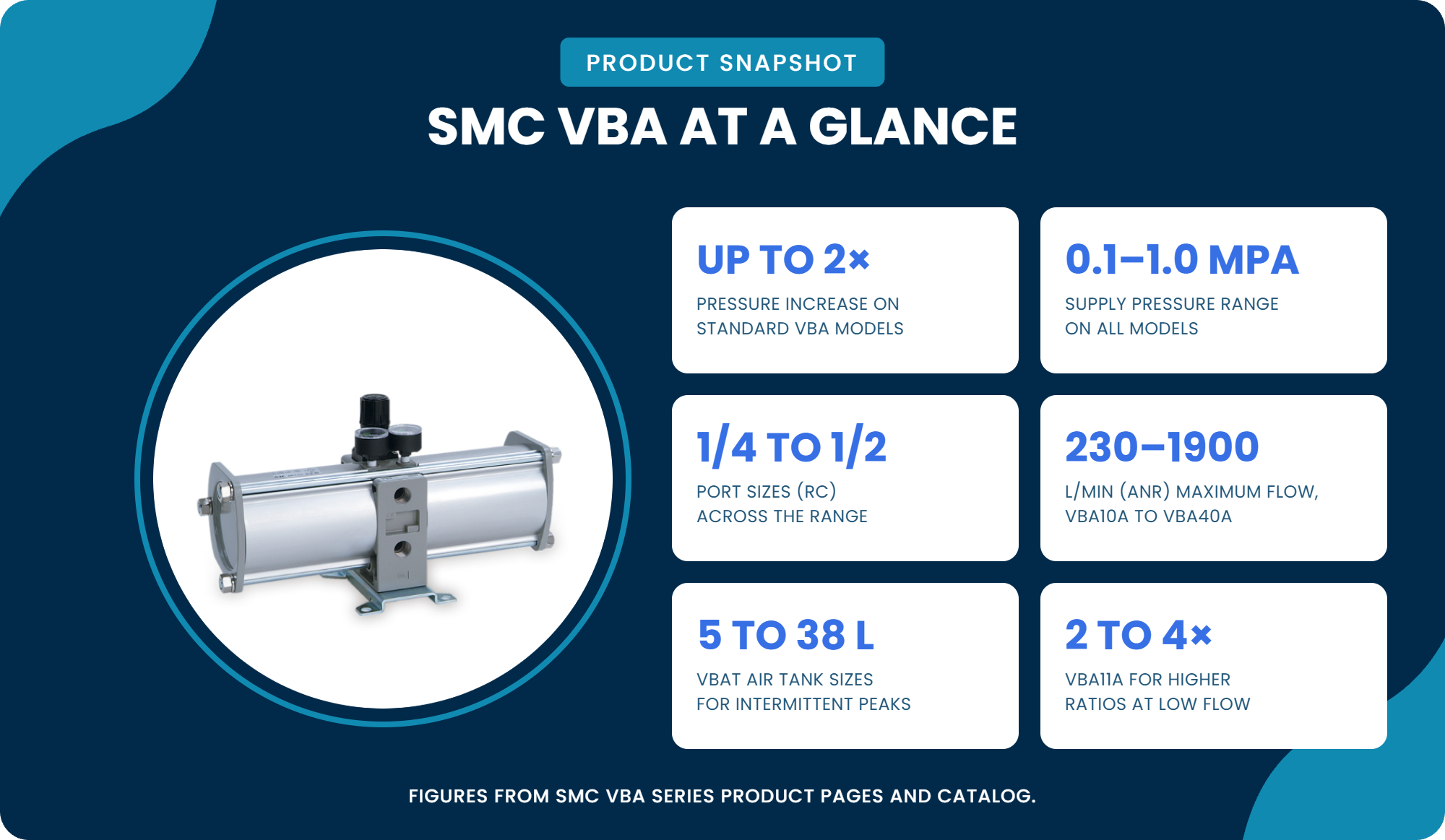
Raises pressure at one machine, up to twice the supply on standard models.
Air Driven
Runs on compressed air alone, with no electrical supply.
Adjustable
Outlet pressure is set by handle, or by pilot pressure on air-operated models.
Sizes
1/4, 3/8 and 1/2 Rc ports, from 230 to 1900 L/min maximum flow.
Air Tanks
VBAT tanks from 5 to 38 L store boosted air for short peaks.
Higher Ratio
The VBA11A boosts 2 to 4 times for low-flow applications.
Sources: SMC VBA booster regulator series and the SMC booster regulator VBA series catalog.
When Another Route May Be Better
- The Whole Plant Needs More Pressure
- Demand Is High and Continuous
- The Actuator Is Already at Its Maximum Pressure
- A Larger Bore or a High-Power Cylinder Such as the SMC CQE Fits
- The Pressure Only Sags Because of an Undersized Supply Line
Checklist: What to Gather Before You Contact Proax
A Booster Sizing Review Goes Faster With This Information:
Need More Pressure at One Machine?
Send us the force, supply pressure and air flow you're working with, and our in-house team will help you size a booster and check lead times.